Resources to help you on your Nature Positive mission!
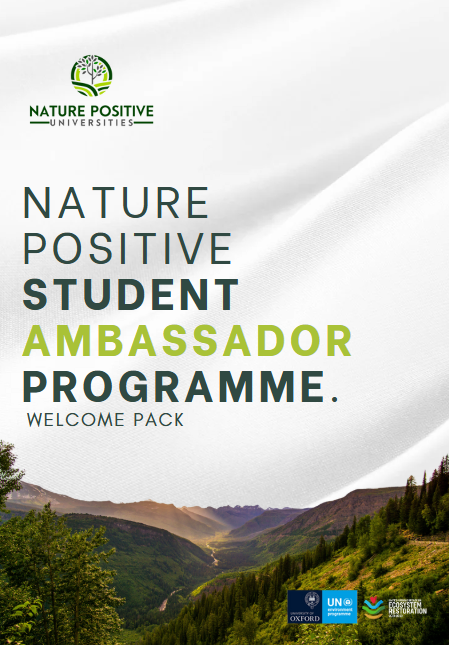
Our Student Ambassador Team are very happy to share with you resources to help you on your Nature Positive mission. To start with this includes a Welcome Pack, social media frame and some of the resources from the first workshop.
During the course of the programme, we will share more resources with you and add them to this page, including Toolkits of campus-based actions and the workshop presentation slides, recordings and quizzes. You will also find social media resources and other information to inspire action for biodiversity on your campus and within your community, wherever you are.
Welcome to the Student Ambassador programme!
Workshop 1: Nature Positive (28th November 2025)
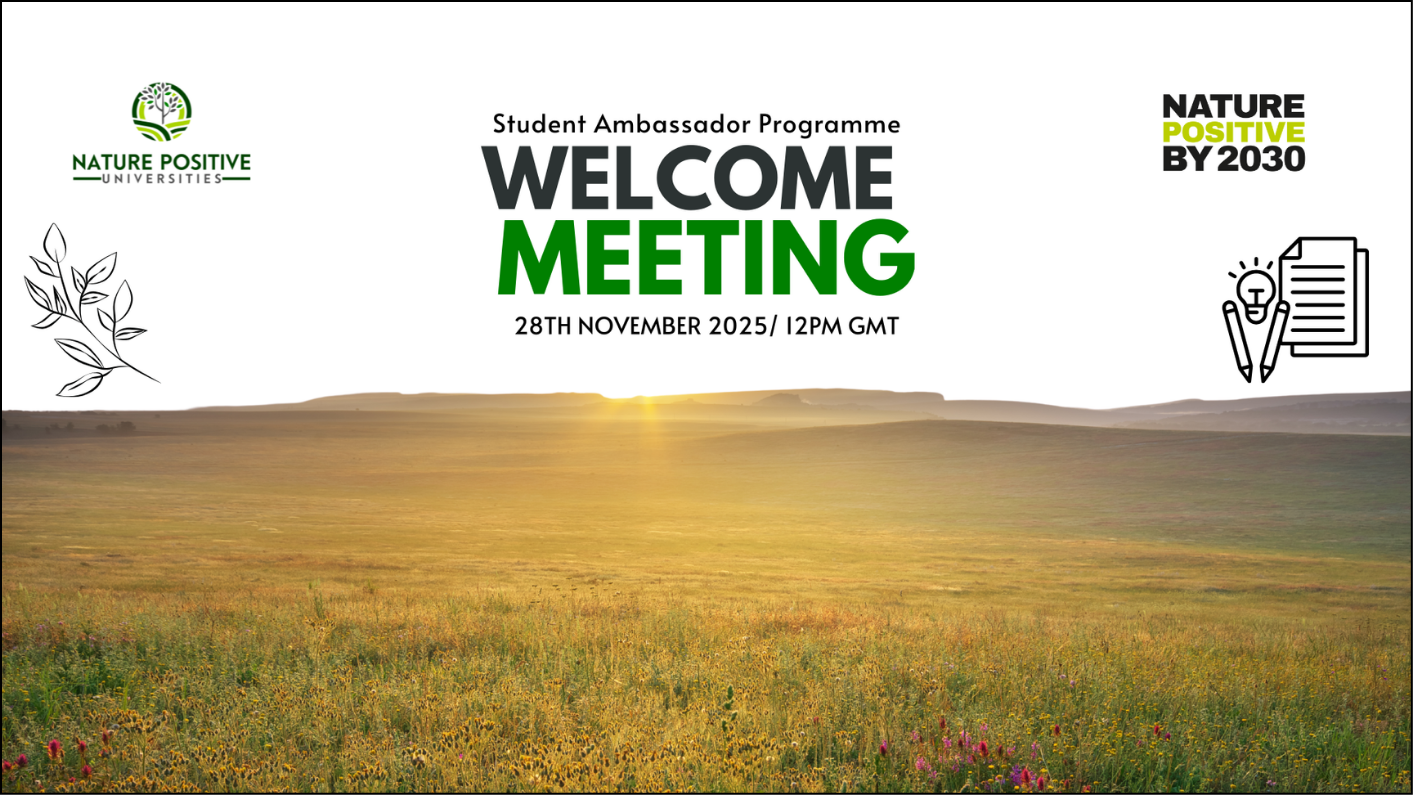
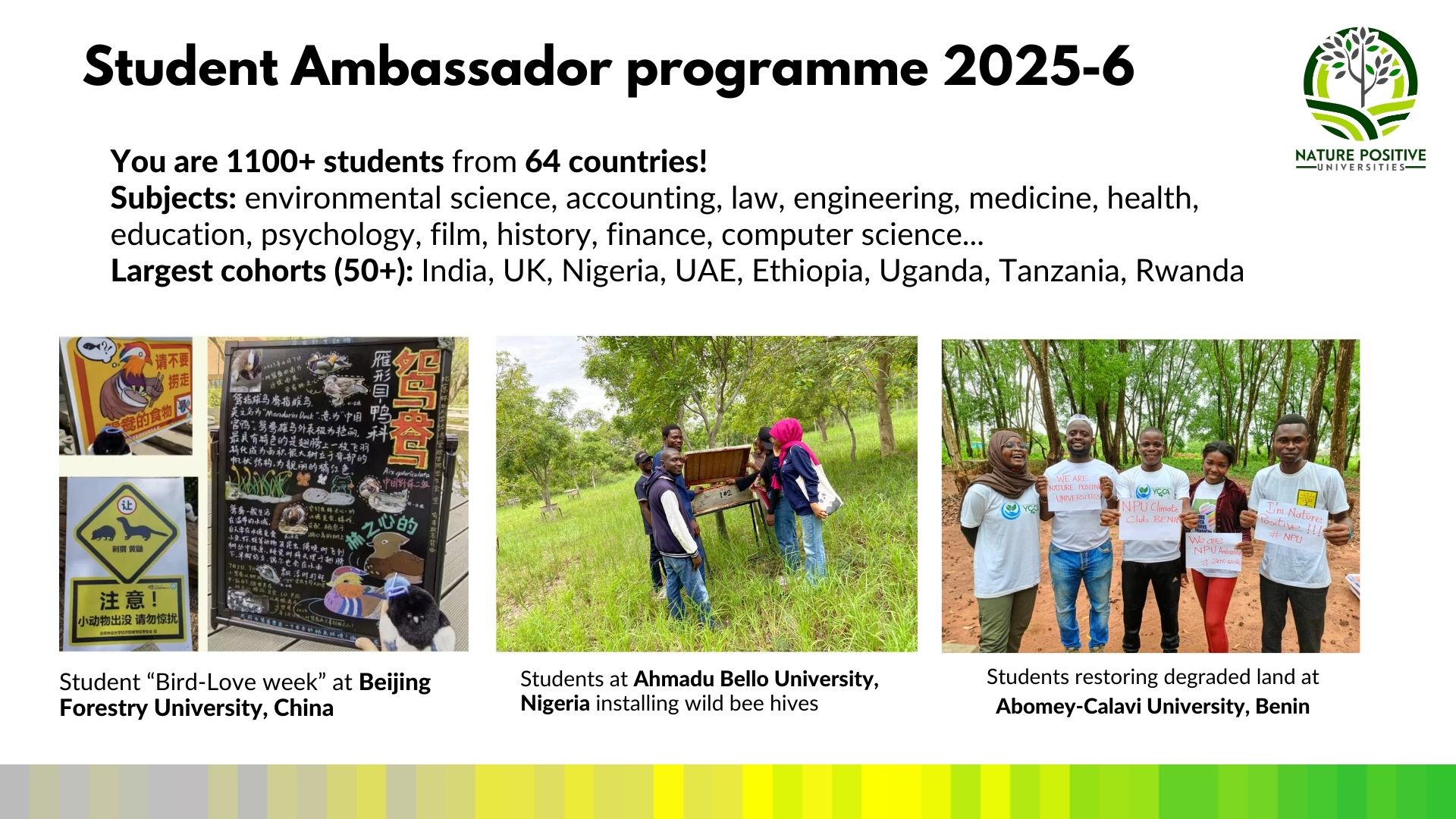
The first workshop in the programme took place on Friday 28th November from 12pm – 1:30pm GMT and was an opportunity to meet the Ambassadors team, learn more about NPU and the Ambassador programme for 2025/26. We also had breakout groups, which was a chance to get to know other Student Ambassadors.
The workshops in this series will then commence again in January 2026 and continue monthly through until May 2026. We understand that not everyone will be able to join us for every workshop due to the timings – the workshops in our programme will take place across a range of times to accommodate different time zones. Recordings will be made available to watch back in case you are unable to attend the workshops.
Zoom automated translated captions are also enabled for our workshops. More information about viewing these captions within Zoom meetings and a list of supported languages for automated captioning in Zoom can be viewed here. As part of the programme this year, we will be having live simultaneous translation of our Zoom workshops into French and Spanish.
Workshop recording
This workshop was delivered in English with live simultaneous translation into French and Spanish. The French and Spanish audio is now available to listen to on the YouTube recording above.
To access the French or Spanish audio, click the ‘settings’ option on the YouTube video, then ‘audio track’ and then select the language you would like.
Workshop slides
Workshop quiz
To accompany each of the workshops, we ask that you complete a short quiz to share your learnings from the workshop with us and also any feedback or suggestions you might have. Please complete these quizzes as soon as you can after attending or watching back the workshops.
The quiz for Workshop 1 contains 10 questions.
This quiz is also now available in French: https://forms.gle/nFCHavtssP4NFMB27
Toolkit
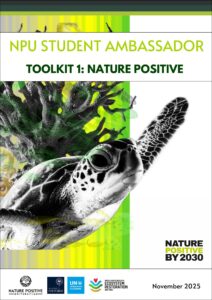
This Toolkit contains information about the specific topics covered in Workshop 1 as well as some suggested actions.
Activity form
The activity form gives you the chance to share your activities with us, whether they are ideas, planned activities, ongoing activities or those that have already taken place.
This form will be open throughout the year and can be completed as many times as you like.
Please note: you will need a Google account in order to access the online version of the form. Alternatively, you can download an offline PDF version of the form below and email it to us at: naturepositiveuniversities@gmail.com.
Student action booklet
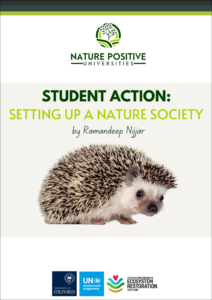
One of our previous student ambassadors, Ramandeep has written a great guide to share her experience of setting up a nature society at her institution.
Click the links to download the document, which is available in Arabic, English, French, Portuguese and Spanish.
Workshop 2: Biodiversity Baselines (30th January 2026)
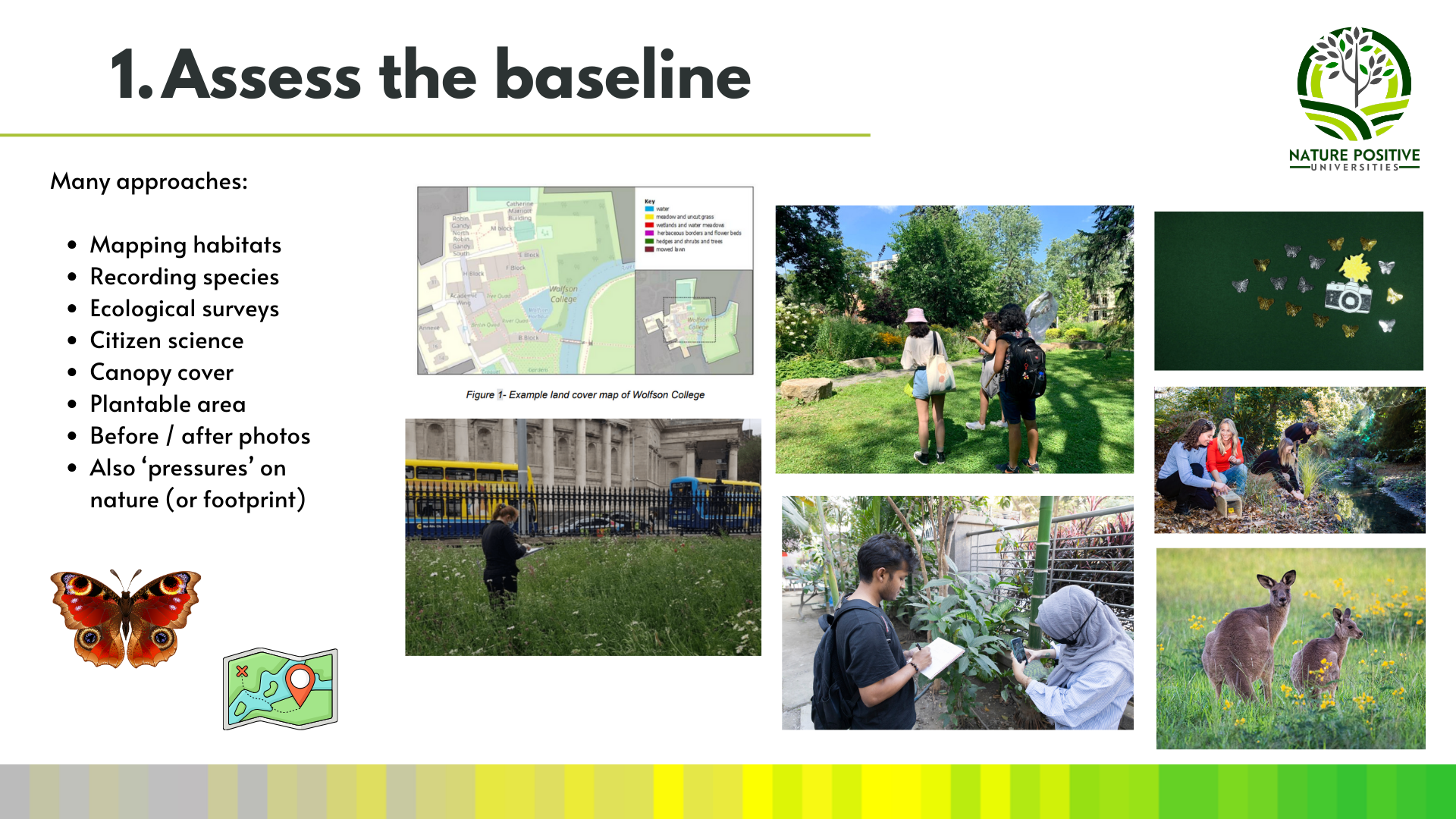
The second workshop in the programme took place on Friday 30th January and during this workshop, we recapped what the global pressures on biodiversity are as well as the shifting baseline syndrome and then considered what are a university’s pressures on biodiversity, and how we could measure these impacts. We then focused on the first step of the pledge: Conducting a “Biodiversity Baseline” and explored some different approaches that you could get involved with on your campus. We also heard from a number of student speakers from a range of countries including Kenya, the United Arab Emirates and the UK, who shared their experience of organising and participating in biodiversity monitoring.
Please see below the workshop recording, presentation slides, workshop quiz, Toolkit and links to the Biodiversity Baselines short film and primer document.
Workshop recording
This workshop was delivered in English with live simultaneous translation into French and Spanish. The French and Spanish audio is now available to listen to on the YouTube recording above.
To access the French or Spanish audio, click the ‘settings’ option on the YouTube video, then ‘audio track’ and then select the language you would like.
Workshop slides
Workshop quiz
Following attending or watching back this workshop, we ask that you complete a short quiz to share your learnings from workshop 2 with us and also any feedback or suggestions you might have.
This quiz is also now available in French: https://forms.gle/mHMDtAg9fwWghX9V8
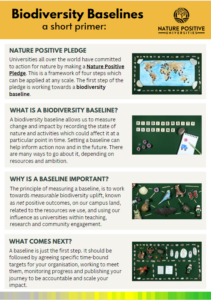
Biodiversity Baselines Film & Primer
Toolkit
This Toolkit contains information about the specific topics covered in Workshop 2 as well as some suggested actions.
Workshop 3: Biodiversity actions on campus (27th February 2026)
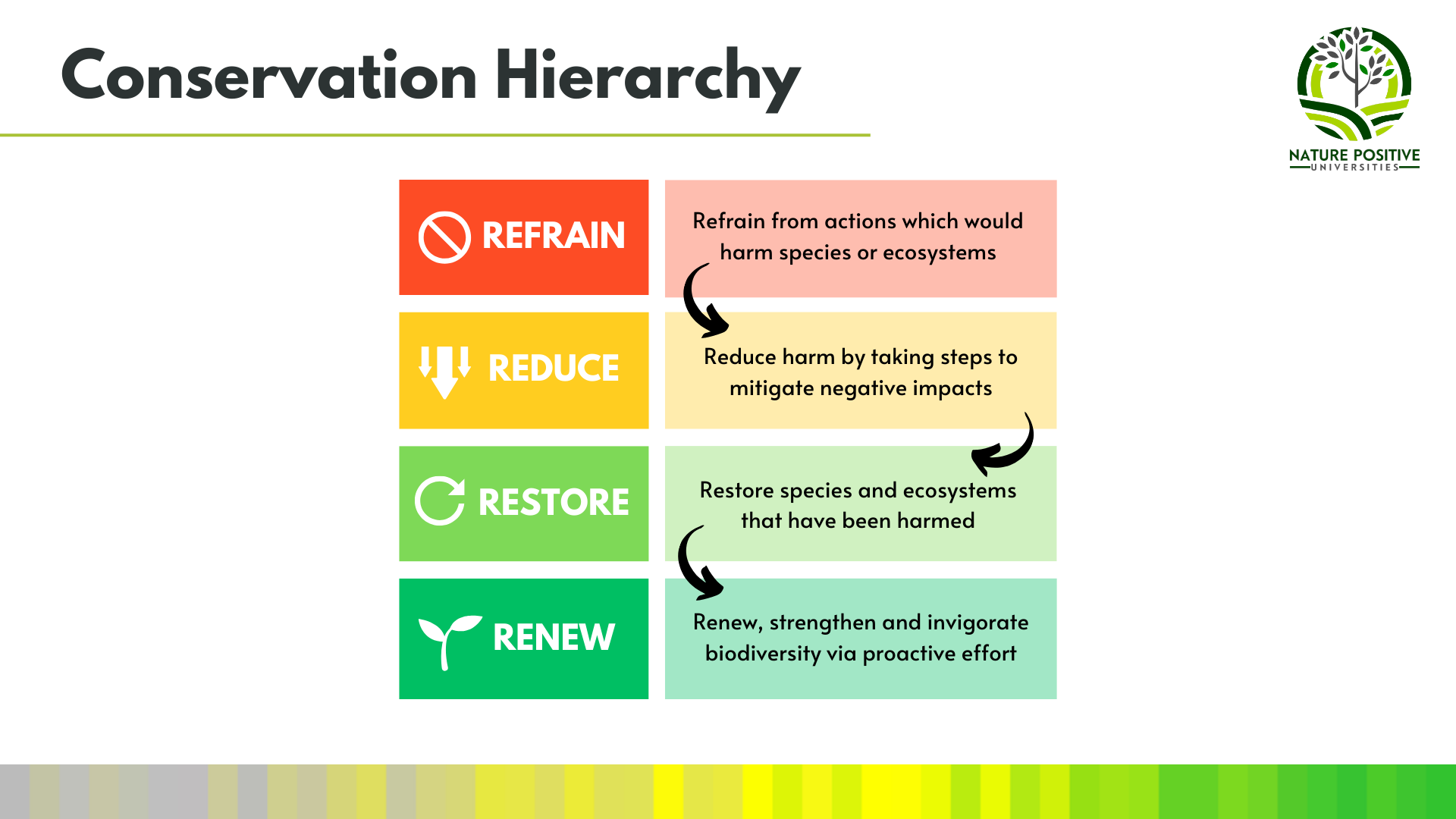
The third workshop in the programme took place on Friday 27th February and in this workshop, we looked at Biodiversity actions on campus, framed by the Conservation Hierarchy. This is a framework that can help you plan actions that could be taken at your university, and we explored examples and advice from the Nature Positive Universities network. We also heard from several Student Ambassadors, who shared their experiences of organising or joining biodiversity actions. These students are:
– Jingyi Pang from Imperial College London, UK spoke about participating in a Campus Bird Collision Prevention Project in China.
– Ahmed Mahmoud Elsayed Ali from Aswan University, Egypt presented about leading environmental awareness and climate adaptation activities through the “Shade Initiative”.
Note: Augustine Allieu from College of Digital Excellence, Sierra Leone was due to present at this workshop about participating in invasive species removals and native tree planting as well as plans to convert underutilized lawn spaces into native pollinator gardens, however Augustine wasn’t able to attend the workshop. We will look to share Augustine’s experience as part of a case study in the Toolkit.
Please see below the workshop recording, presentation slides, workshop quiz and the Toolkit.
Workshop recording
This workshop was delivered in English with live simultaneous translation into French and Spanish. The French and Spanish audio is now available to listen to on the YouTube recording above.
To access the French or Spanish audio, click the ‘settings’ option on the YouTube video, then ‘audio track’ and then select the language you would like.
Workshop slides
Workshop quiz
Following attending or watching back this workshop, we ask that you complete a short quiz to share your learnings from workshop 3 with us and also any feedback or suggestions you might have.
Toolkit
This Toolkit contains information about the specific topics covered in Workshop 3 as well as some suggested actions.
Workshop 4: Sustainable food (27th March 2026)
The fourth workshop in the programme took place on Friday 27th March and during this workshop, we explored a variety of approaches to Sustainable Food, including revisiting the Conservation Hierarchy, which is a framework that we introduced in Workshop 3, that can help you plan actions that could be taken at your university, and then explored examples of actions for your campus around food from across the NPU network. We also heard from two student speakers, who shared their experience of projects focused on the topic of Sustainable food. The students are:
– Israel Tade from l’Université Peleforo GON COULIBALY, Côte d’Ivoire who shared ideas and plans for a project entitled ‘Le programme Mon arbre mon fruit’ (‘My tree, my fruit’) about food growing on campus.
– Haleema Raza Khan from the University of Oxford, UK who presented about participating and winning the Vice Chancellor’s Colloquium on Climate Change with a proposal to tackle food insecurity in Oxford by redistributing surplus food from colleges.
Please see below the workshop recording, presentation slides, workshop quiz, and Toolkit.
Workshop recording
This workshop was delivered in English and French with live simultaneous translation into English, French and Spanish. You can access the video recording with English, French or Spanish audio available to listen to on the YouTube recording above.
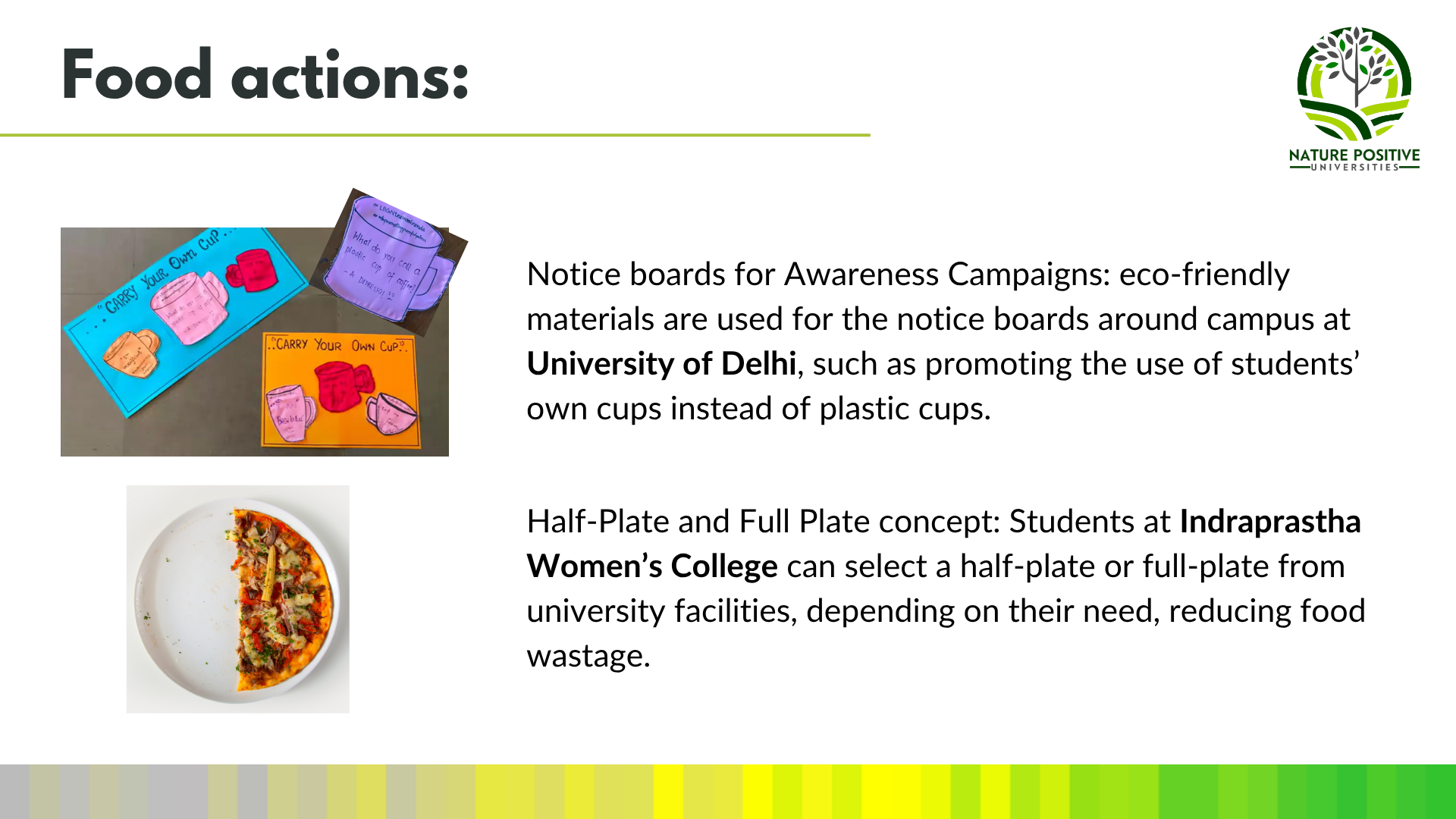
Workshop slides
Workshop quiz
Following attending or watching back this workshop, we ask that you complete a short quiz to share your learnings from workshop 4 with us and also any feedback or suggestions you might have.
Toolkit
This Toolkit contains information about the specific topics covered in Workshop 4 as well as some suggested actions.
Workshop 5: Waste and Resource Use (24th April 2026)
The fifth workshop in the programme took place on Friday 24th April. In this workshop, we explored impacts and actions around Waste and Resource Use and the circular economy, framed by the Conservation Hierarchy. This is a framework that we’ve introduced previously, that can help you plan actions that could be taken at your university and in your communities. We then explored examples of actions for your campus from the Nature Positive Universities network and had breakout rooms where we discussed ideas and examples for tackling waste and resource use.
Additionally, we heard from a number of student speakers, who shared their experiences organising or taking part in projects focused on waste and resource use. These students are:
– Amensinor Favour Okpohs from Ulster University, UK presented about delivering swap shops and repair cafes on campus to encourage reuse and reduce waste.
– Monika Dadhich and Varushi from Indraprastha College For Women, University of Delhi, India presented about leading Anti-Littering campaigns, supporting the vision of a Plastic-Free Campus and also contributing to a Book Exchange Drive.
– Laura Sofía Ávila, Santiago Figueroa Soto and Federico Teran Pascuas from Pontificia Universidad Javeriana Cali, Colombia presented about two projects that have been developed at the university during this semester, ‘Towards a Zero Waste Campus’ and ‘Plogging session’.
Please see below the workshop recording, presentation slides, workshop quiz and a new Student Action document. The Toolkit for this workshop is coming soon!
Workshop recording
This workshop was delivered in English with live simultaneous translation into French and Spanish. The French and Spanish audio is now available to listen to on the YouTube recording above.
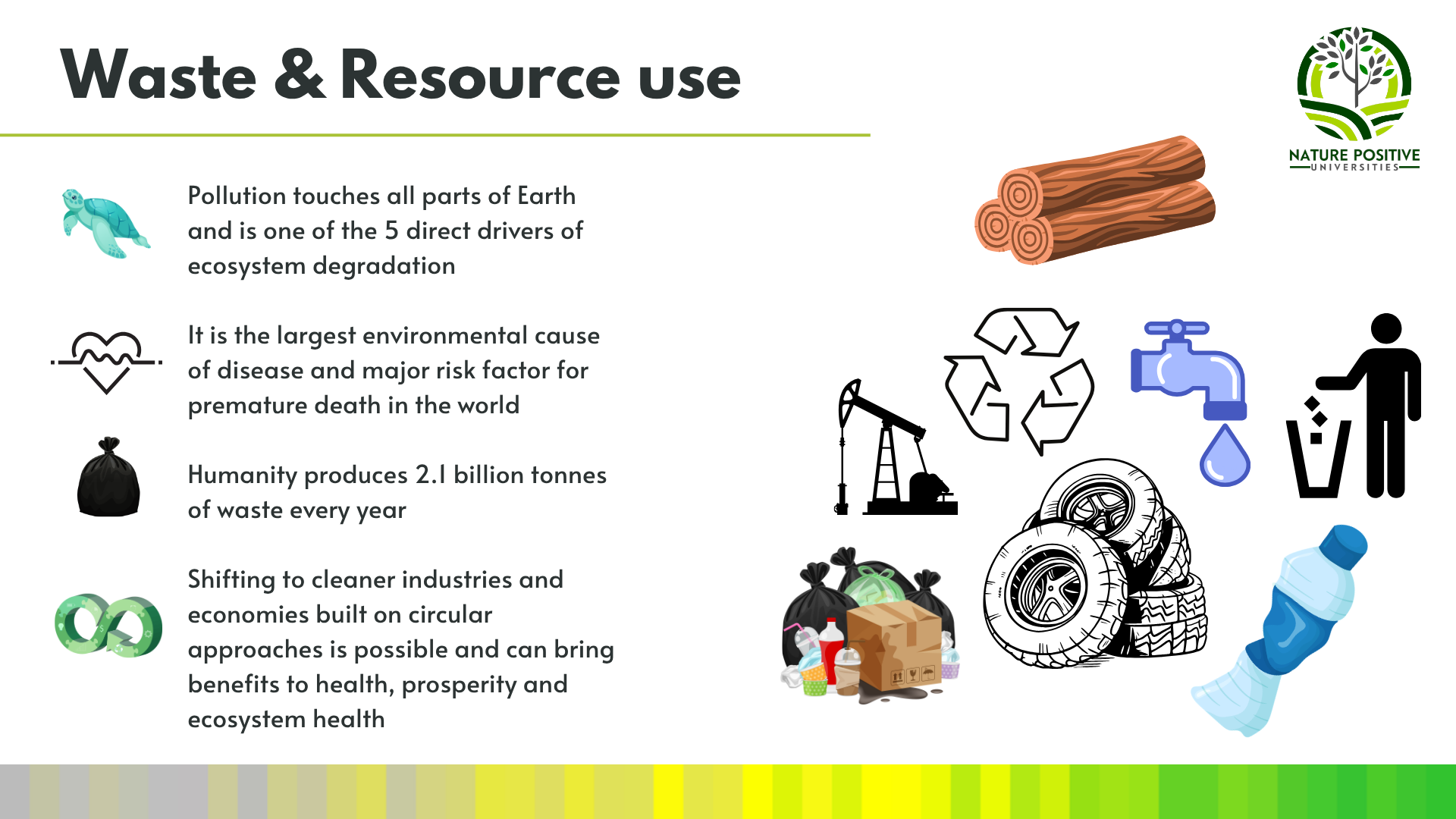
Workshop slides
Workshop quiz
Following attending or watching back this workshop, we ask that you complete a short quiz to share your learnings from workshop 5 with us and also any feedback or suggestions you might have.
Student action booklet
We’re excited to share with you a new student action document, which is focused on funding for nature based activities and was written by Abigail Kos who is a Student Ambassador from The Open University, UK.
Click the links to download the document, which is currently available in Arabic, English and French.
Toolkit
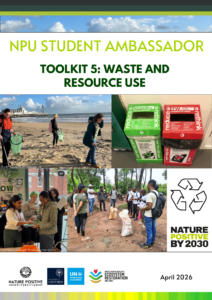
This Toolkit contains information about the specific topics covered in Workshop 5 as well as some suggested actions.
Workshop 6: Advocacy, green skills and jobs (29th May 2026)
The sixth and final workshop in the programme took place on Friday 29th May and during this workshop, we explored actions around advocacy and community engagement from the Nature Positive Universities network. We also heard from two student speakers, who shared their experiences, which we hope provided ideas for how to take your learnings from the programme forward. The student speakers were:
- Anna Asim from Fatima Jinnah Women University Rawalpindi, Pakistan who presented about the use of communications and PR as advocacy tools, drawing on work on the Plastic Free July campaign, participation as a climate panellist and launching an independent food security initiative.
- Amina Othman from University of Abuja, Nigeria spoke about her use of spoken word poetry and storytelling to raise awareness on nature conservation and inspire youth-led action. Please see below some recordings that Amina shared with us of her poetry and spoken word.
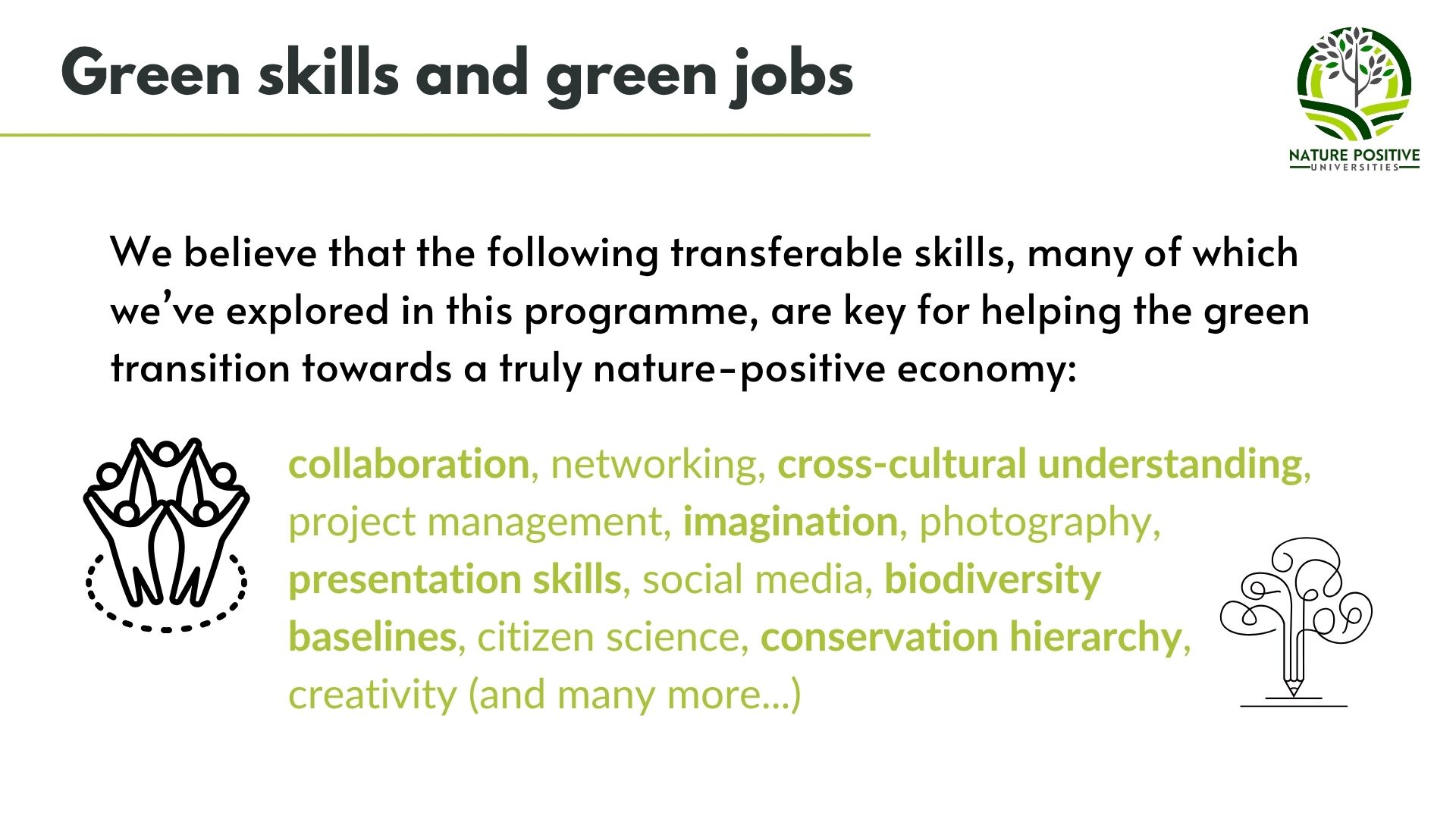
Additionally, we had breakout rooms, which were a chance to explore the concepts of green skills and green jobs, and an opportunity to share experiences, challenges and ideas of your next steps following completion of the 2025/26 Nature Positive Student Ambassador Programme. During this session, we also launched a poll to gather feedback about the programme. There will also be an opportunity to share feedback with us in the end of year form.
Note: Anwar Ghusub Salum from Sokoine University Of Agriculture (SUA), Tanzania was due to present in this workshop about his work with the Watoto na Mazingira Initiative, organising clean-ups, leading tree planting and mobilising school children in biodiversity awareness, however Anwar wasn’t able to attend the workshop. We hope to be able to share Anwar’s experience with everyone at a later date.
Please see below the workshop recording, presentation slides, workshop quiz, Toolkit and end of year feedback form:
Workshop recording
This workshop was delivered in English with live simultaneous translation into French and Spanish. The French and Spanish audio is now available to listen to on the YouTube recording above.
Workshop slides
Workshop quiz
Following attending or watching back this workshop, we ask that you complete a short quiz to share your learnings from workshop 6 with us and also any feedback or suggestions you might have.
Toolkit
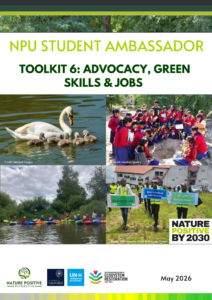
This Toolkit contains information about the specific topics covered in Workshop 6 as well as some actions.
End of year feedback form
This form is an opportunity for you to share your feedback with us about the programme, indicate if you wish to continue on the programme, joining the 2026/27 cohort and to share with us any final information about activities and projects you’re planning, are currently taking place or have already happened.
There is also a chance to indicate if you’d like to participate in an optional focus group to share further feedback with us about your experience of the programme.
Poetry and spoken word recordings - Amina Othman
We’re pleased to share links to some examples of Amina’s poetry and spoken word:
https://drive.google.com/file/d/1rALLwyMai4UkLyrR3y6Z_6FVY2-qmJm-/view?usp=sharing
https://drive.google.com/file/d/11qvzTARtGexeUCGTGqH97L4Vyr_-6ui6/view?usp=sharing
Social media graphics
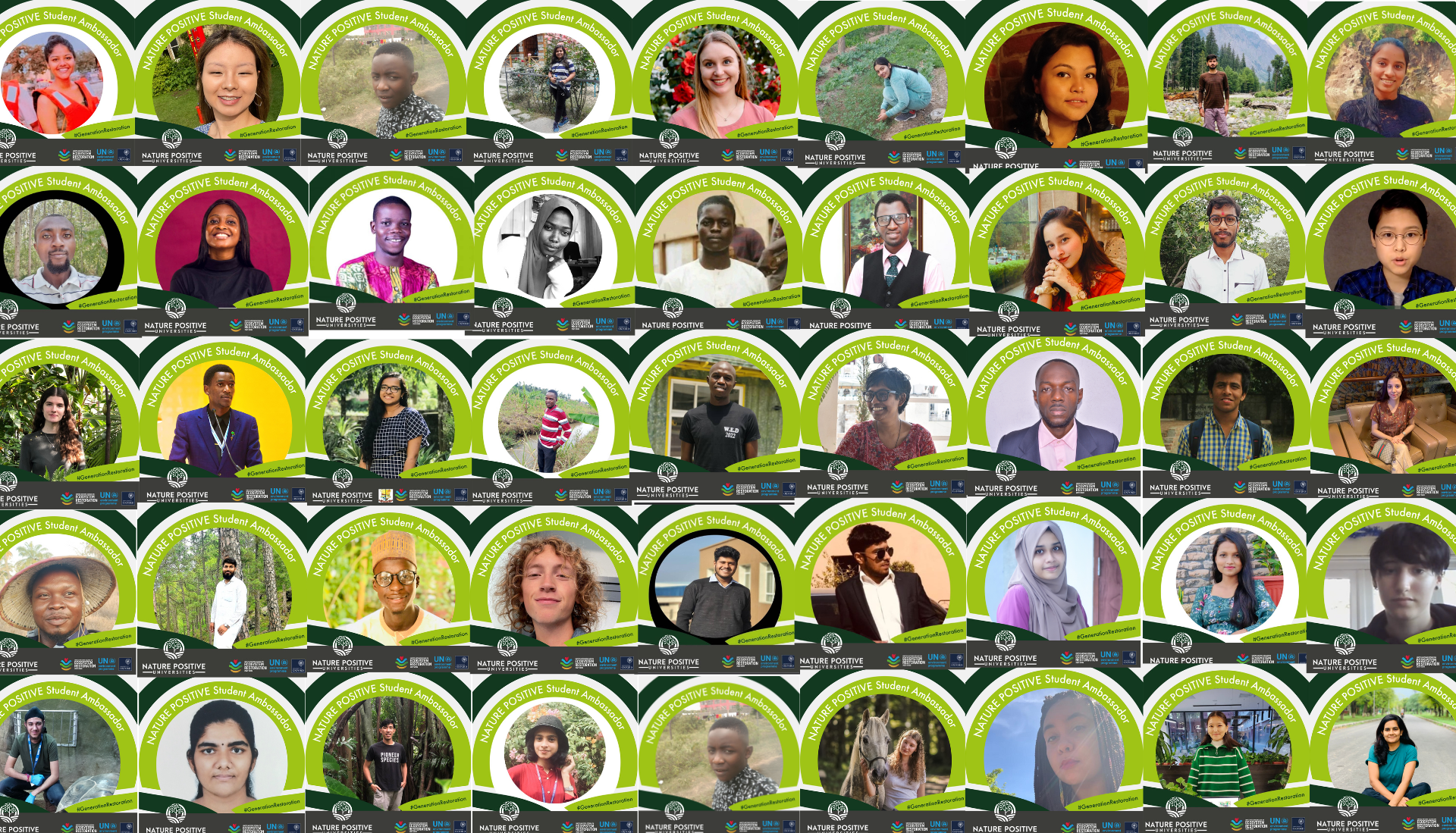
Many of you have social media accounts, such as Instagram, LinkedIn and X. We have created a frame which you can use to promote your activities as a Student Ambassador. Please use the #GenerationRestoration to link up with our partners at the UN Decade on Ecosystem Restoration and remember to tag us in your posts.
- Instagram: @NaturePositiveUniversities
- LinkedIn: @Nature-Positive-Universities
- X: @NaturePosUni
“I am excited to announce that I’ve been selected as a Student Ambassador with Nature Positive Universities! This programme empowers students from higher education institutions with the practical knowledge to tackle activities driving the loss of biodiversity in their university and campus and I’m thrilled to join this inspiring network. #generationrestoration #naturepositive”
“I am excited to announce that I’ve been selected as a Student Ambassador with Nature Positive Universities! This programme empowers students from higher education institutions with the practical knowledge to tackle activities driving the loss of biodiversity in their university and campus and I’m thrilled to join this inspiring network. #generationrestoration #naturepositive”
Celebrate International Days
International Days can be a great opportunity to highlight some of your recent actions or raise awareness on a particular issue. One of our Ambassadors, Favour Ochuwa from University of Benin Nigeria has developed a range of social media cards for you to use to celebrate days relevant to our programme.
Feel free to use these, and add your own photos, words, and stories to your posts on social media to encourage others to take action on the issue.
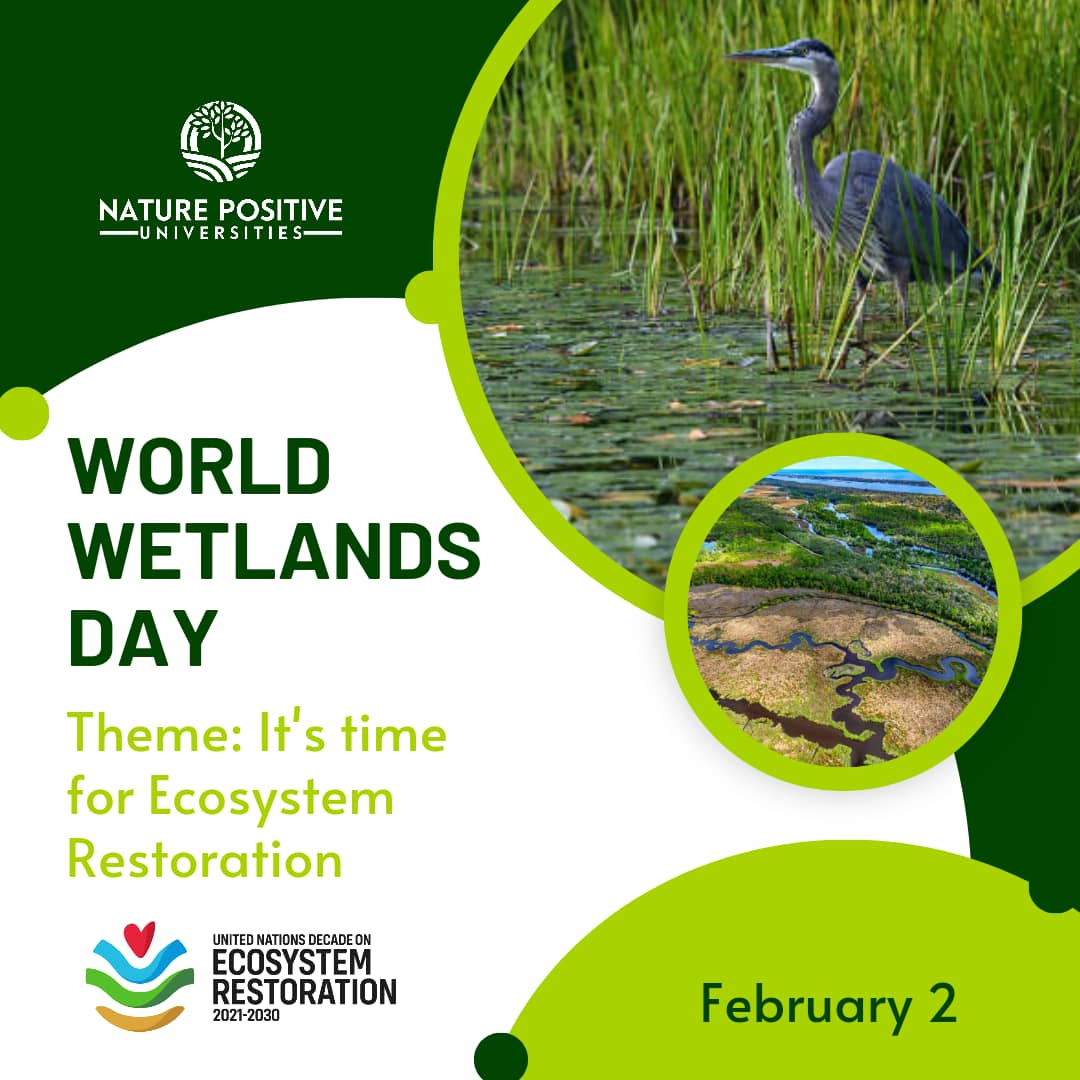
Wetlands_2nd Feb
Water_22nd March
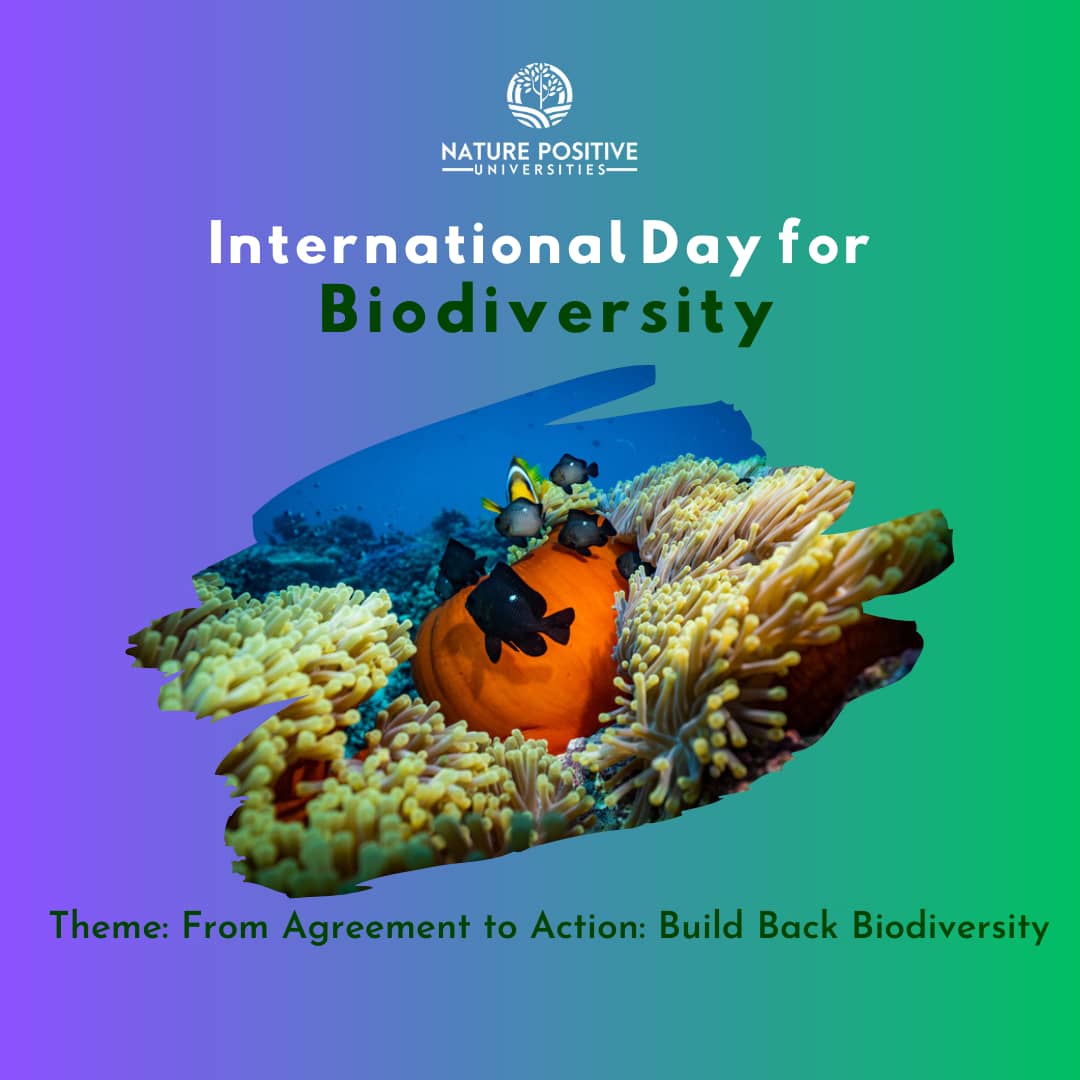
Biodiversity Day_22 May
Earth Day guide
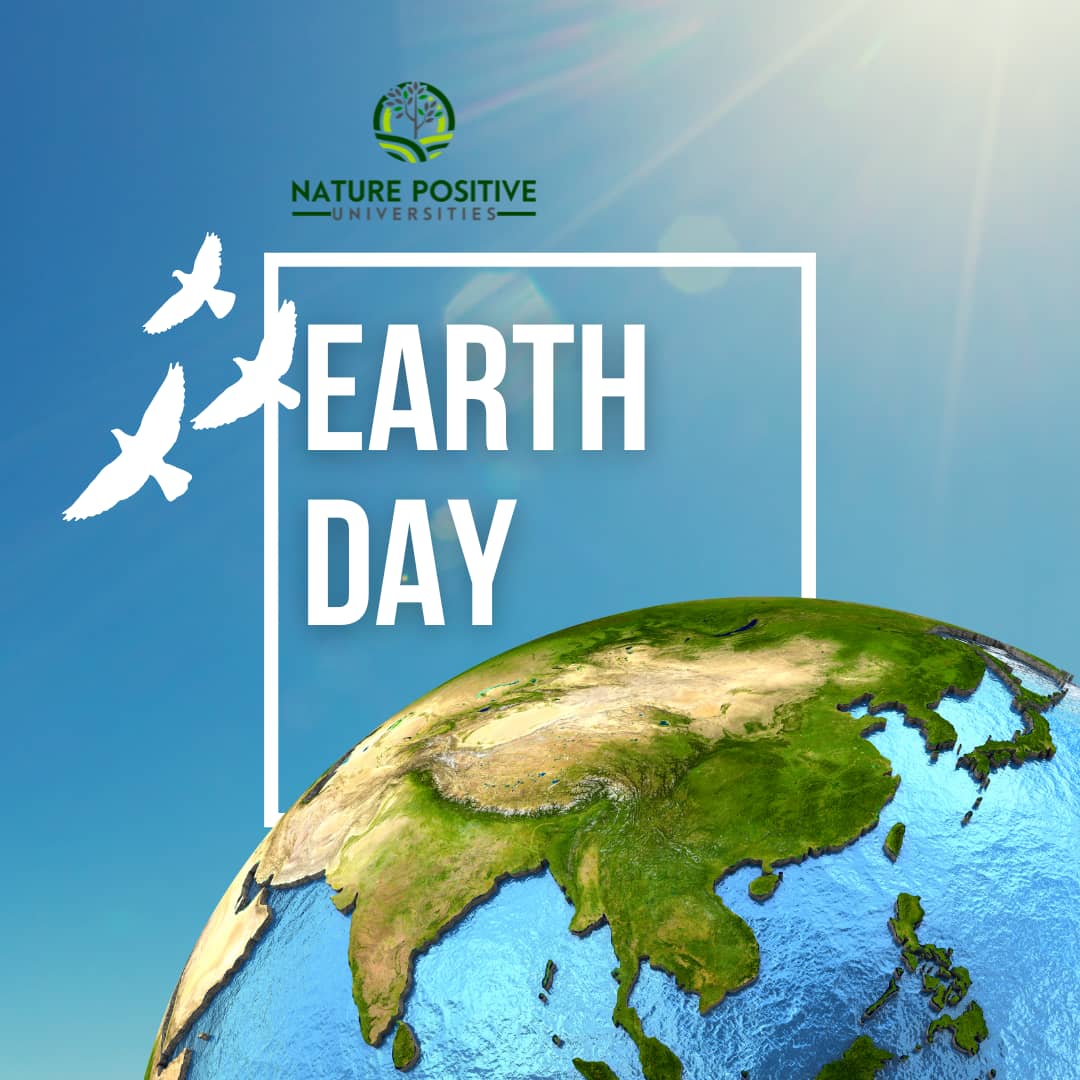
Earth Day
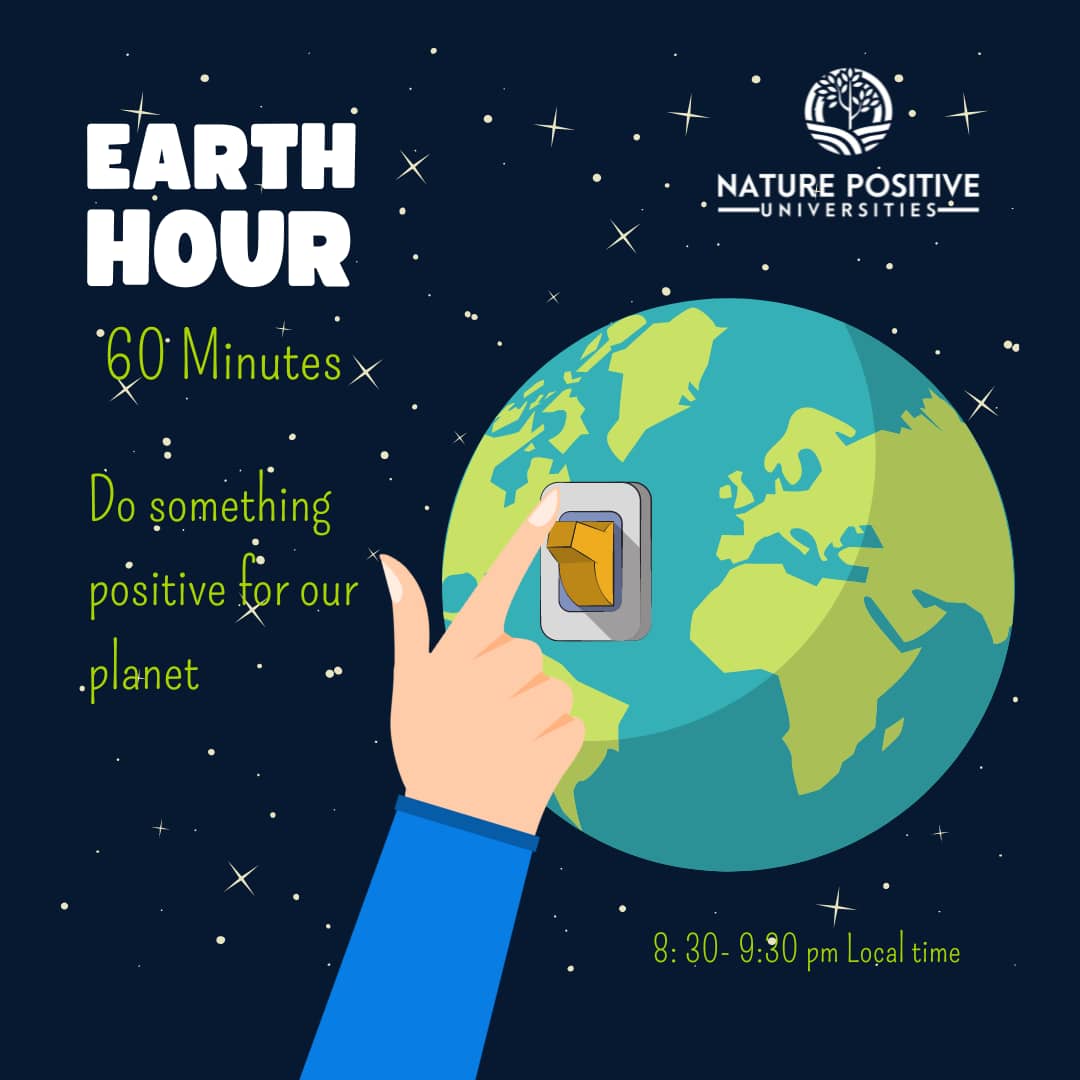
Earth Hour
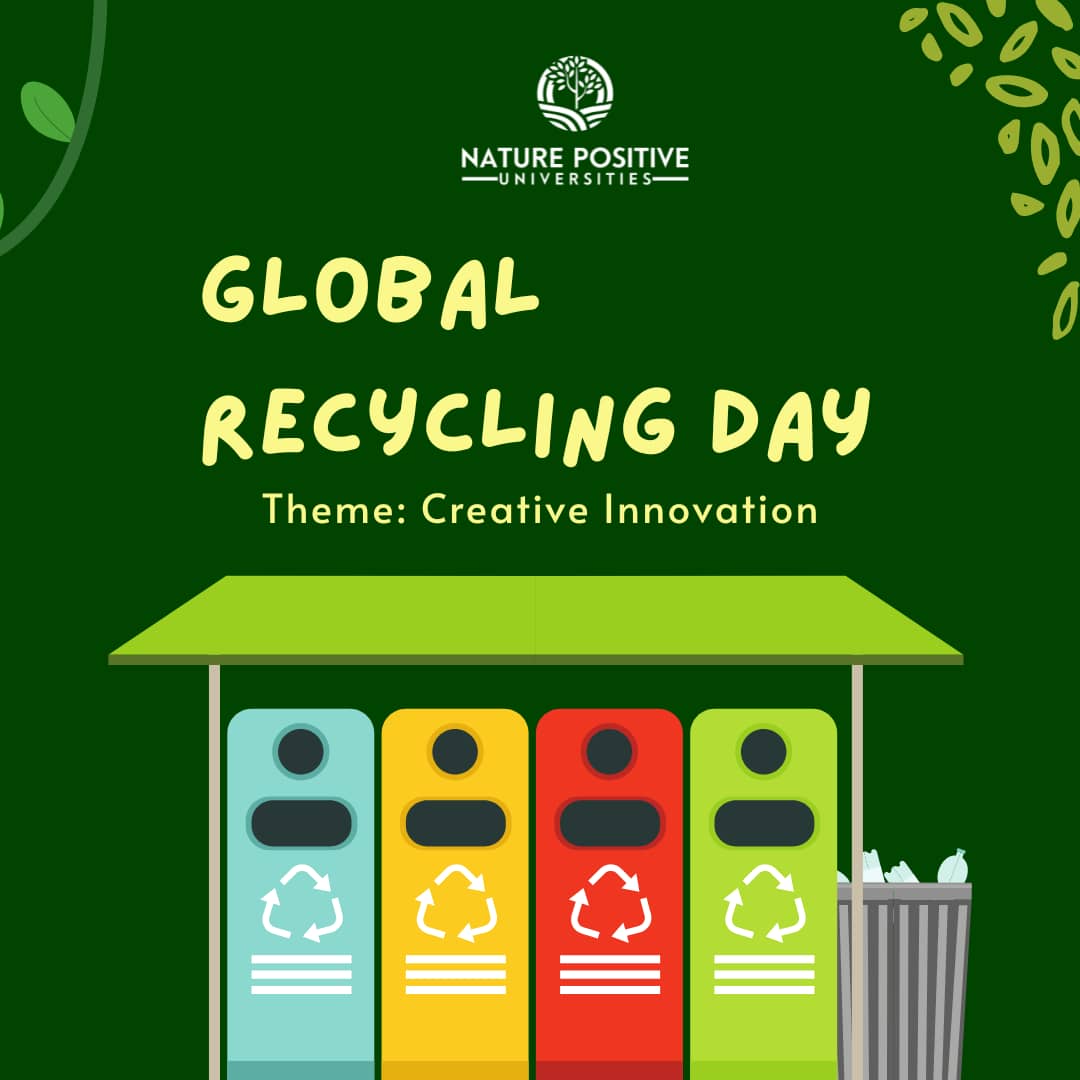
Recycling
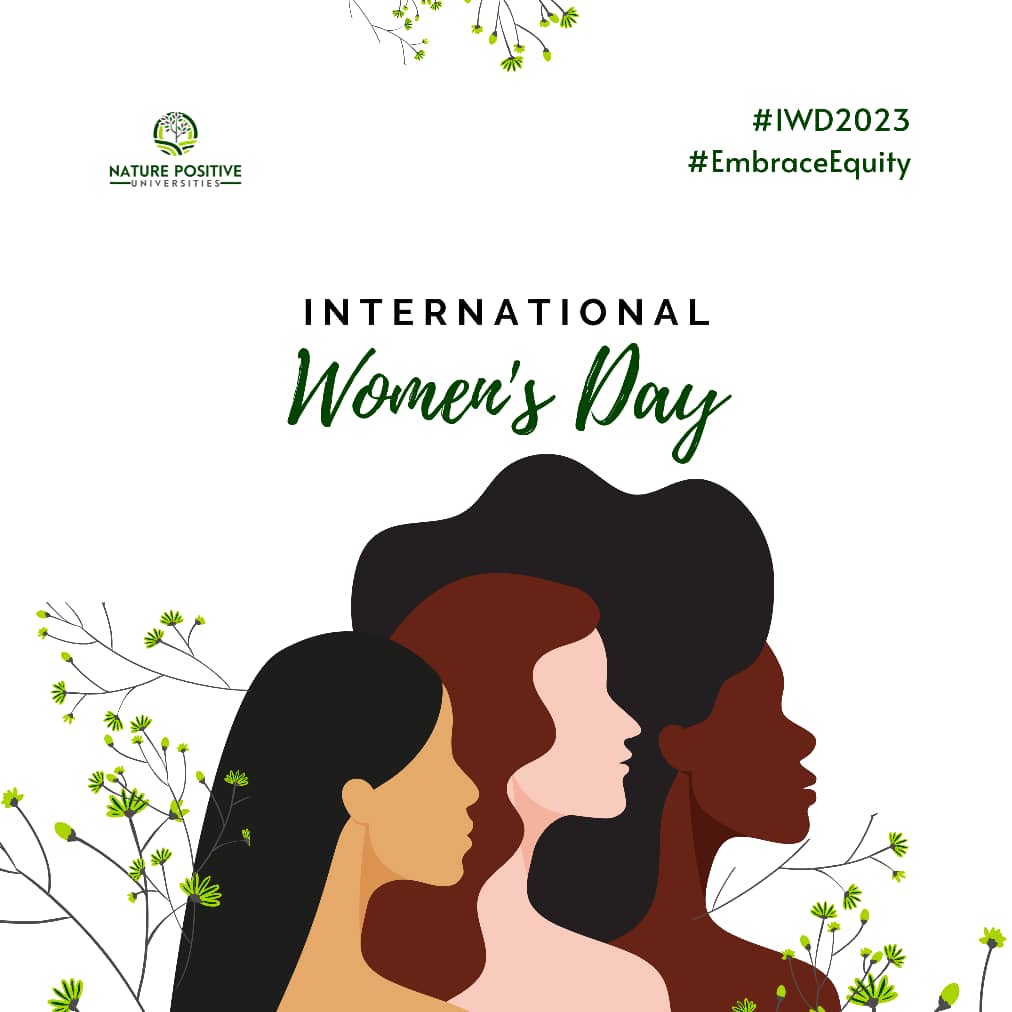
Women’s Day
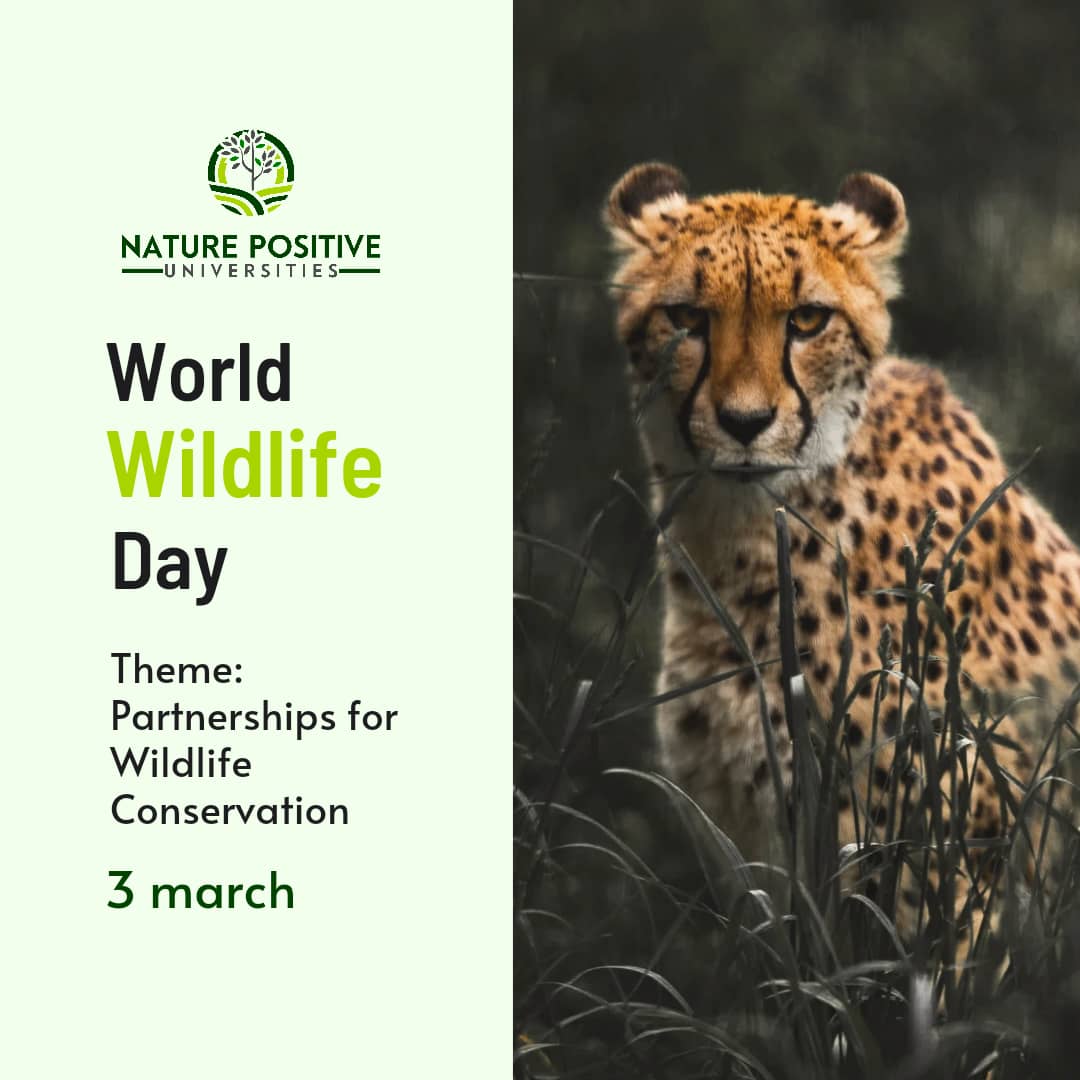
World Wildlife Day
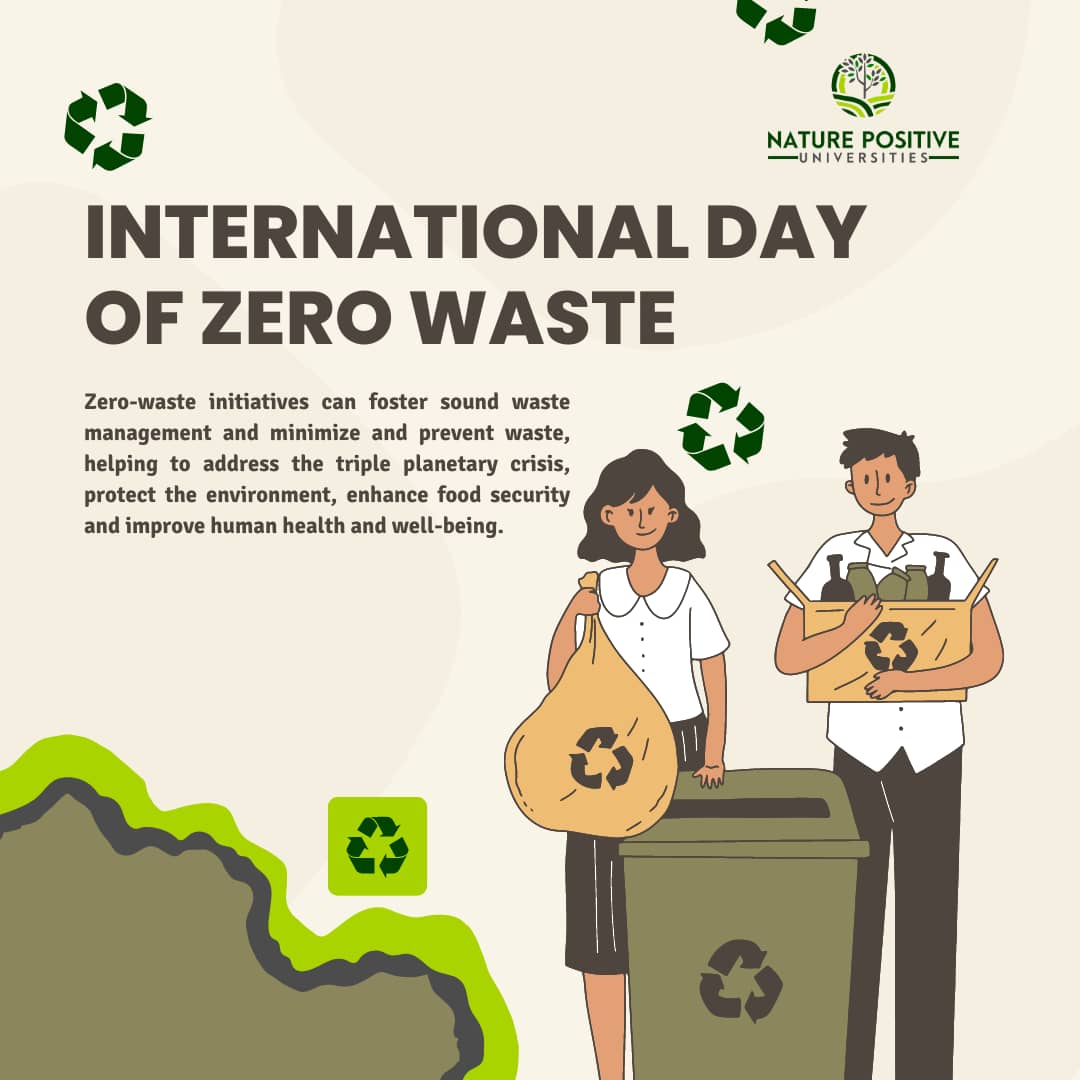
Zero Waste Day
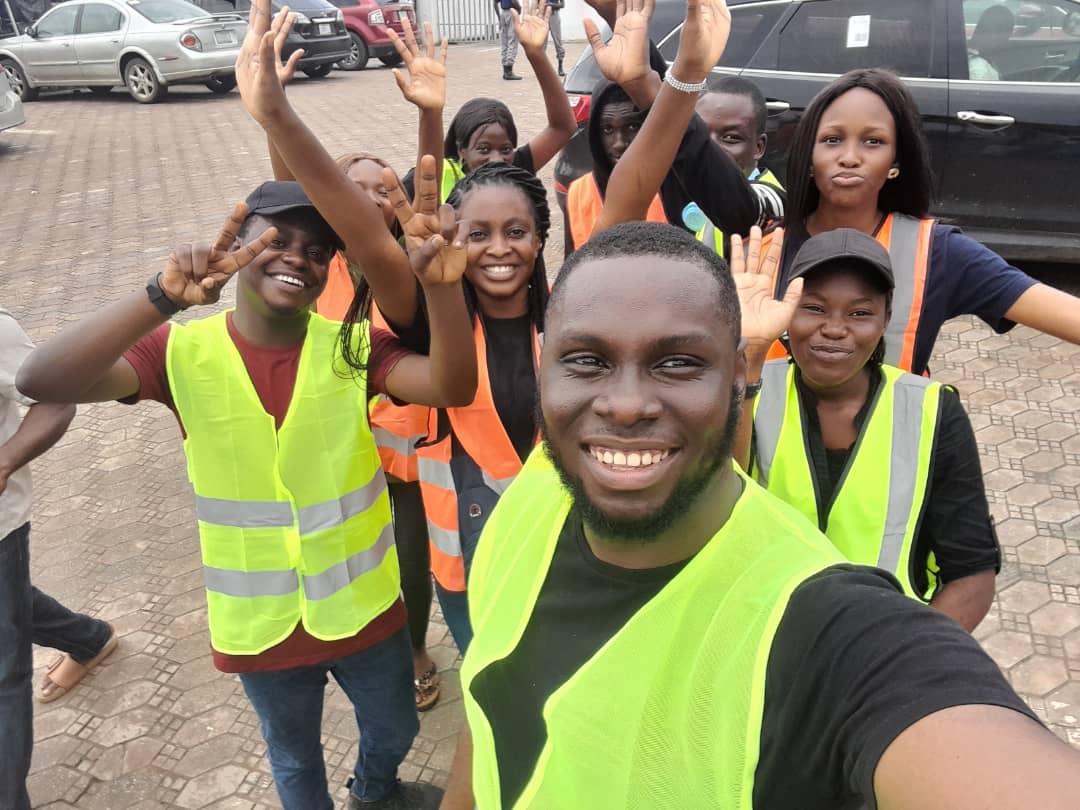
Join the community
Workshops –
We have a monthly video meeting schedule to catch up with your fellow Ambassadors with discussions on different topics, such as wildlife recording, sustainable food, waste and volunteering for ecological restoration.
Previous meeting:
- Kick-off meeting (Workshop 1): 28th November 2025, 12pm – 1:30pm GMT (90-minutes)
- Workshop 2 – Biodiversity Baselines: 30th January 2026, 10am – 11am GMT (1-hour)
- Workshop 3 – Biodiversity actions on campus: 27th February 2026 at 1pm – 2pm GMT (1-hour)
- Workshop 4 – Sustainable food: 27th March 2026 at 10am – 11am GMT (1-hour)
- Workshop 5 – Waste and resource use: 24th April 2026 at 1pm – 2pm BST (1-hour)
- Workshop 6 – Advocacy & green skills and jobs: 29th May 2026 at 12pm – 1:30pm BST (90-minutes)
Join our friendly WhatsApp Community group to hear the latest activities of the team. You should have received a link via email.
Any questions?
Need anything else, want to add your resources to help others? We would love to work with you, just reach out to us.